Let’s be real for a minute. Finding a crypto exchange that doesn’t give you a headache is harder than it should be. Since the big industry shake-ups a few years ago (we all remember 2022), I’ve been on a constant hunt for a platform that feels safe, works fast, and doesn’t ask for my blood type just to trade a few hundred dollars.
You have the giant exchanges that feel like banks, stiff, regulated, and sometimes a bit overwhelming. Then you have the “Wild West” decentralized exchanges (DEXs), where you have total control, but you also risk buying a scam coin every other Tuesday.
I stumbled upon BYDFi a while back, initially drawn in by the buzz around their massive list of altcoins. I’ve been using it for both standard spot trading and some higher-risk leverage plays, and more recently, I’ve been testing their new Web3 tool, MoonX.
If you are currently sitting on the fence, wondering if this exchange is legitimate or just another flash in the pan, this review is for you. I’m going to break down everything, the good, the bad, and the features that actually matter to regular traders like us.
What Exactly is BYDFi?
First off, a little housekeeping. You might remember a platform called “BitYard” that was popular a few years ago. In 2023, they rebranded to BYDFi (which stands for “BUIDL Your Dream Finance”.
They are headquartered in Singapore but have obtained Money Services Business (MSB) licenses in both the United States and Canada. This is a big deal. Usually, exchanges that offer high leverage options operate from a hidden island somewhere. The fact that BYDFi has registered in North America adds a layer of legitimacy that makes me sleep a little better at night.
For those who take their charting and leverage seriously, BYDFi: best alternative for derivatives traders has become a go-to recommendation in many trading communities, largely because they offer professional-grade tools without the restrictive barriers of entry found elsewhere.
The “No-KYC” Advantage: Why It Matters
Let’s talk about the elephant in the room: Identity Verification.
Most big exchanges now require you to upload your passport, take a selfie, and practically sign a sworn affidavit before you can deposit $50. While I understand the need for regulation, sometimes you just want to move fast. Maybe you want to keep your privacy, or maybe you just don’t want to wait 48 hours for a support agent to approve your documents.
BYDFi is one of the few reliable platforms left that is “No-KYC mandatory” for most operations. You can sign up with just an email or a phone number. You can deposit crypto, trade spot, trade futures, and even withdraw (up to a certain daily limit, usually around 0.5 BTC to 2 BTC depending on the current policy) without ever sending them your ID.
For me, this was the hook. I could sign up and start trading in literally 30 seconds.
User Interface and Experience (UX)
The Desktop Experience
When you first log in, the dashboard feels familiar. If you have used Binance, KuCoin, or Bybit, you will feel right at home. They haven’t tried to reinvent the wheel, which is a good thing.
The layout is clean. You have your “Markets” tab, “Spot,” “Derivatives,” and “Copy Trading” clearly labeled at the top. The charting is powered by TradingView, which is the industry standard. This means you can use all your favorite indicators—RSI, MACD, Bollinger Bands—without fighting a clunky proprietary chart.
One thing I appreciate is the “Light” vs “Dark” mode toggle. It sounds simple, but staring at a bright white screen at 2 AM is painful. The Dark mode on BYDFi is easy on the eyes with nice contrast, making those red and green candles pop without burning your retinas.
The Mobile App
I do about 60% of my trading on my phone while I’m away from my desk. The BYDFi app (available on iOS and Android) is surprisingly robust. It’s not just a “lite” version of the site; it’s a full-featured trading terminal.
You can execute complex orders, manage your copy trading portfolio, and even access the MoonX Web3 features directly from the app. It’s snappy, doesn’t crash (a low bar, I know, but you’d be shocked how many exchange apps freeze during volatility), and the navigation is intuitive.
Trading Features: The Meat and Potatoes
Spot Trading: An Altcoin Hunter’s Paradise
If you only trade Bitcoin and Ethereum, you can use any exchange. The reason to use BYDFi is the variety. They list over 1000 cryptocurrencies. We are talking about everything from the blue chips (SOL, BNB, XRP) to the trending AI tokens and gaming coins.
They are usually very quick to list trending coins. When a coin starts blowing up on Twitter (X), it usually lands on BYDFi weeks before it hits the major US exchanges. This gives you a chance to get in early on centralized liquidity without having to fiddle with a DEX.
Derivatives and Futures: High Risk, High Reward
This is where BYDFi flexes its muscles. They offer Perpetual Contracts (USDT-M and COIN-M).
- USDT-M: You use Tether (USDT) as collateral. This is easier for most people because your profit and loss are calculated in dollars.
- COIN-M: You use the coin itself (like BTC or ETH) as collateral. This is great if you are a long-term holder and want to accumulate more of the coin while trading.
The leverage goes up to 200x on major pairs like Bitcoin. Now, I have to be the responsible friend here: Do not use 200x leverage unless you know exactly what you are doing. You will get liquidated if the price sneezes in the wrong direction. However, having the option for 20x or 50x is great for experienced scalpers.
They also offer “Lite Contracts” for beginners. These simplify the interface, removing the complex order book and just giving you a simple “Long/Short” mechanism. It’s a good way to learn, but I recommend graduating to the standard Perpetual interface quickly to get better control over your fees and entry prices.
Copy Trading: Let the Pros Do the Work
BYDFi pushes their Copy Trading feature hard, and for good reason. It’s one of the smoothest implementations I’ve seen.
Here is how it works: You browse a list of “Master Traders.” You can see their ROI (Return on Investment), their Win Rate, and their history. Once you find someone who looks profitable, you click “Copy.”
The system then automatically mimics their trades in your account. If they buy Bitcoin, you buy Bitcoin. If they sell, you sell. You can set limits, like “only invest $100 total” or “stop copying if I lose $20,” so you aren’t giving them blank check access to your funds.
My Advice: Be careful here. Don’t just look at the highest ROI. Look for traders with a long history.
MoonX: The Web3 Cheat Code
This is the newest addition to the BYDFi ecosystem, and honestly, it deserves its own section because it solves a massive pain point for meme coin traders.
If you have ever tried to trade a brand new coin on the Solana or BNB chain, you know the struggle. You have to find the contract address, go to a DEX like Raydium or PancakeSwap, adjust your slippage, and pray the transaction doesn’t fail.
MoonX is a tool built into BYDFi that simplifies this entire process.
Finding the 1000x Gems
MoonX categorizes coins by their lifecycle stages. You can see:
- Newly Created: Tokens that were literally just deployed. Extreme risk, but this is where the 100x moves happen.
- Approaching Full Liquidity: Tokens that are gaining traction and are about to fill their bonding curves (on launchpads like Pump.fun).
- Launched: Tokens that are fully trading on the open market.
Having this data visually organized saves you from having to monitor twenty different Telegram channels.
Security Scans Built-In
This is my favorite part. In the Wild West of meme coins, “Rug Pulls” and “Honeypots” are everywhere. A Honeypot is a scam token that you can buy but cannot sell.
MoonX integrates scanners from GoPlus, Honeypot Detector, and QuickIntel. When you look at a coin, you see a simple safety score:
- Green: Safe to trade.
- Yellow: Caution.
- Red: High Risk/Scam.
They even simulate a sell transaction in the background to confirm it’s not a honeypot. This feature alone has saved me from throwing money into a few obvious scams that looked good on the chart.
The “Same-Block” Copy Trading Innovation
Standard copy trading has a delay. By the time your account copies a “Whale” (a rich, smart trader), the price might have already jumped up.
MoonX uses “Same-Block” technology. This ensures that your copy trade happens in the exact same block on the blockchain as the master trader. This minimizes slippage and ensures you get the same entry price as the “Smart Money” you are following. It’s a technical marvel that levels the playing field for retail traders.
Fees: Are They Competitive?
Fees can eat your profits alive if you aren’t careful. Here is the breakdown for BYDFi:
- Spot Trading: The standard fee is around 0.1% to 0.3% depending on the pair. This is pretty standard for the industry—comparable to Binance or KuCoin.
- Perpetual Futures:
- Maker Fee (Limit Orders): 0.02%
- Taker Fee (Market Orders): 0.06%
These futures fees are actually very competitive. Many exchanges charge 0.06% or higher for Takers. If you use Limit orders (providing liquidity), 0.02% is very cheap.
- Overnight Fees: There are no overnight funding fees in the traditional sense, but like all crypto perp exchanges, there is a “Funding Rate” that is paid every 8 hours between Longs and Shorts to keep the price tethered to the spot price. This is standard market mechanics, not a platform fee.
Deposits and Withdrawals
Crypto Deposits
This is the best way to fund your account. It’s free (aside from the network gas fee you pay from your wallet). It supports all major chains (TRC20, ERC20, BEP20, Solana). If you have USDT on Tron (TRC20), sending it to BYDFi takes about 2 minutes.
Buying with Fiat (Credit/Debit Card)
BYDFi does not have a direct bank wire system. Instead, they partner with payment processors like Banxa, Transak, and Mercuryo.
- The Process: You say “I want to buy $500 of BTC.” You are redirected to Banxa. You pay with your Visa/Mastercard. The crypto arrives in your BYDFi wallet.
- The Cost: This is where you need to pay attention. These third-party providers usually charge a fee of anywhere from 2% to 4%. It is convenient, but it is expensive. If possible, I always recommend buying crypto on a local regulated exchange (like Coinbase or Kraken) and transferring it to BYDFi to save on fees.
Withdrawals
Withdrawals are straightforward. You enter your wallet address, complete your 2FA (email + Google Authenticator), and send. In my experience, withdrawals are processed within 10 to 30 minutes. I have never had a withdrawal “stuck” for days, which is a horror story I’ve heard about other platforms.
Security: Is My Money Safe?
After the collapse of FTX, we all have trust issues. Is BYDFi safe?
While no centralized exchange is 100% risk-free (not your keys, not your coins), BYDFi takes the right precautions:
- Cold Storage: They claim to store the vast majority of user funds in deep cold storage (offline wallets) that cannot be hacked via the internet.
- Multi-Sig Wallets: Moving funds requires multiple approvals, preventing a single rogue employee from draining the treasury.
- Regulation: As mentioned, the dual MSB licenses in the US and Canada show a willingness to comply with major financial regulations.
- Security Settings: As a user, you can (and should) enable Google Authenticator, Email verification, and a “Fund Password” (a separate password needed just to withdraw money).
Customer Support
This is often where exchanges fail. I tested BYDFi’s support anonymously to see how they would handle it.
- Live Chat: They have a chat icon on the bottom right. I messaged them at 11 PM on a Tuesday asking about deposit fees. I was connected to a human (not a bot!) within roughly 2 minutes. The agent was polite and actually answered the question rather than pasting a link to a generic FAQ.
- Help Center: Their FAQ section is decent. It covers the basics of how to trade, how to copy trade, and how to secure your account.
They don’t seem to have phone support, but honestly, almost no crypto exchange does. The responsiveness of the Live Chat was a huge plus for me.
Pros and Cons Breakdown
To summarize, here is the quick view:
Pros
- No Mandatory KYC: Huge for privacy and speed.
- Massive Coin Selection: Over 1000+ assets including new meme coins.
- MoonX Integration: Best-in-class tools for on-chain degens (safety scans, same-block copy trading).
- US/Canada MSB Licenses: Adds a layer of trust.
- Great Mobile App: Fully functional and stable.
- Competitive Fees: Especially for Maker orders on futures.
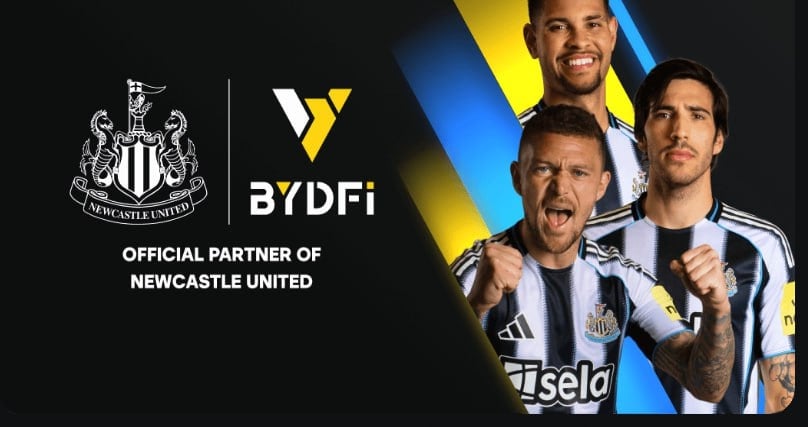
- Partnership with Newcastle United: Greater Influence
Cons
- Less well-known than major exchanges.
Conclusion
So, is BYDFi the right exchange for you?
If you are a complete beginner who just wants to buy $50 of Bitcoin and hold it for ten years, you might be better off with a simple app like Coinbase.
However, if you are a trader, someone who wants to explore altcoins, use leverage, try out copy trading, or hunt for the next 100x meme coin, BYDFi is easily one of the best options on the market right now.
It strikes a rare balance. It has the professional tools and liquidity of a major exchange, but it retains the flexibility and “degen-friendly” features (like No-KYC and MoonX) that crypto natives love.
For me, it has replaced three other apps on my phone. Instead of using a separate app for charts, a separate wallet for meme coins, and a separate exchange for futures, I can do it all here.